Historic East Orange company once sold radioactive water as medicine
Bailey Radium Laboratories sold bottled radioactive water as medicine in the late 1920s. One person consumed about 1,300 bottles.
More Stories


In the late 1920s, long before federal regulators cracked down on false health claims, an East Orange company was selling bottled radioactive water as medicine.
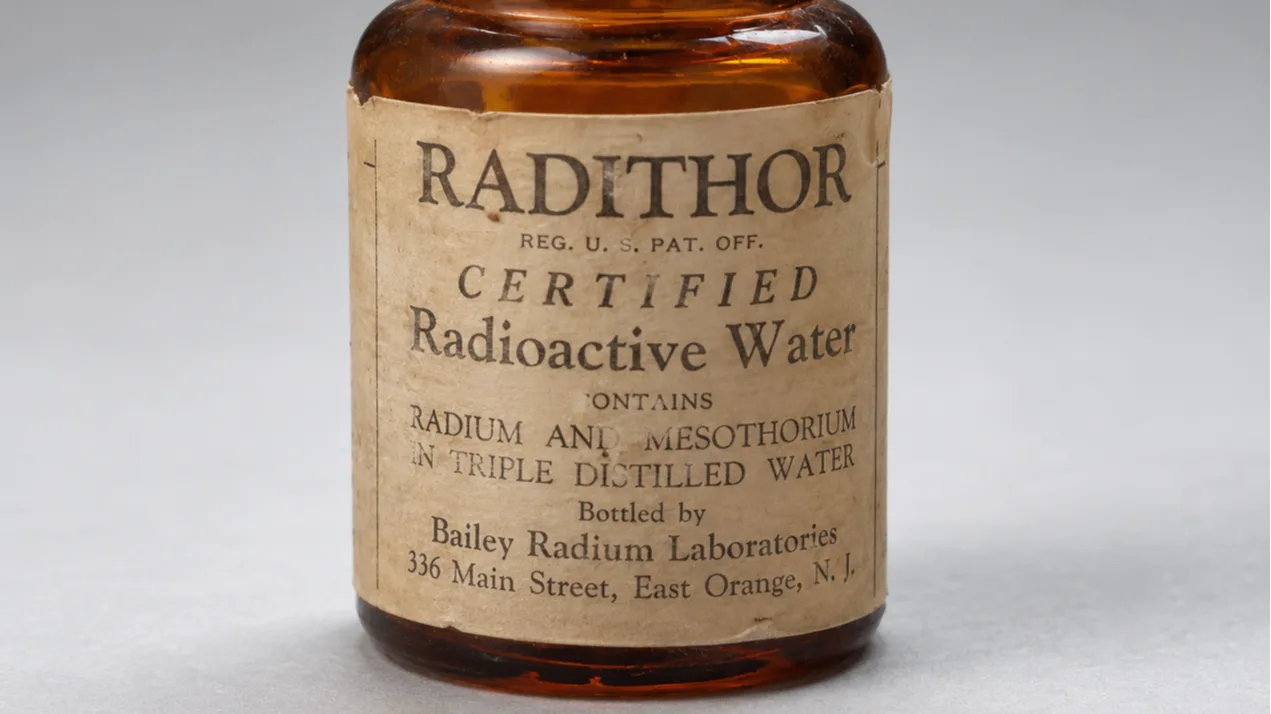
The product was called Radithor, and the water really was radioactive. A surviving bottle in the Smithsonian's National Museum of American History is labeled “Certified Radioactive Water” and says it contained radium and mesothorium in triple-distilled water. Its label identifies Bailey Radium Laboratories at 336 Main St. in East Orange.
William J.A. Bailey guaranteed customers were getting the radioactive material they were promised. Contemporary medical investigators reproduced an offer from Bailey to pay $1,000 to anyone who could prove bottles leaving his operation did not contain the radioactive material he promised.
Bailey, the company's president, treasurer and principal stockholder, promoted Radithor as a treatment for a wide range of ailments. The Federal Trade Commission later charged that the company represented it as a treatment or cure for more than 160 conditions or symptoms, including high blood pressure, arthritis, sexual decline, indigestion and even wrinkles.
Behind Bailey Radium Laboratories
The advertising surrounding Radithor portrayed it as the product of years of scientific research. The FTC's complaint described a much simpler process behind the product.
City directories from the period placed Bailey Radium Laboratories in the Commonwealth Building at 336 Main St. Other tenants included a secretarial school, engineers and other businesses.
The complaint said Bailey Radium Laboratories made Radithor by diluting concentrated radioactive fluid purchased from another company with distilled water.
The FTC charged the company with misleading consumers about the scientific research behind Radithor. Its subsequent order prohibited Bailey from implying that the product was manufactured in a laboratory owned or operated by the company. It also restricted promotional materials with misleading authorship and physician endorsements not based on clinical experience with Radithor.
The man who drank about 1,300 bottles
One of Radithor's most enthusiastic customers was Eben Byers, a wealthy Pittsburgh industrialist and nationally prominent amateur golfer. Byers had twice finished runner-up in the U.S. Amateur before winning the championship in 1906 at Englewood Golf Club in New Jersey.
Contemporary reporting said Byers hurt his arm when he fell from an upper berth on a train in 1927. A Pittsburgh physiotherapist recommended Radithor. Byers believed the drink eased his pain and made him feel better, and he became an enthusiastic user.
He eventually consumed about 1,300 bottles, according to an FTC account.
By the time federal investigators took Byers' testimony, he was suffering from pronounced necrosis, or tissue death, of the jaw. His physician testified that the condition was caused by radium poisoning.
Byers was too ill to appear before the commission, according to contemporary accounts. Robert Hiner Winn, an FTC attorney, instead went to Byers' Southampton, New York home in 1931 to interview him.
Federal scrutiny of Radithor had begun well before Byers died. The FTC filed its complaint against Bailey and his company on Feb. 5, 1930. After testimony was taken, Bailey and the company withdrew their answer and said they would no longer contest the case. The commission issued its decision and order on Dec. 19, 1931.
How could radioactive water be legal?
Federal drug law worked very differently at the time.
The Food and Drug Administration's own history says Radithor, despite being extremely dangerous, was accurately labeled as radioactive water and was therefore legal under the 1906 Pure Food and Drugs Act. The law prohibited adulterated and misbranded drugs but provided no way to remove a drug from the market simply because it was inherently dangerous.
The FTC proceeding instead targeted claims used to sell Radithor, including representations about its safety, therapeutic benefits and scientific development.
Radithor was not North Jersey's only encounter with the dangers of radium. In neighboring Orange, workers at U.S. Radium Corp. painted watch and instrument dials with luminous radium paint. The plant became associated with the New Jersey workers known as the Radium Girls.
At roughly the same time, an East Orange business was marketing radioactive material for people to drink.
Byers died in 1932. The FTC later reported that he died from conditions induced by radium poisoning.
Bailey's involvement in radioactive health products did not immediately end with Radithor. In 1932, the American Medical Association documented his association with the Thoronator, a device advertised as turning ordinary tap water into radioactive water, and other radiation-based products.
Nearly a century later, a Radithor bottle survives in the Smithsonian. Printed on its label beneath the promise of radium and mesothorium in triple-distilled water is the address where Bailey's company once operated: 336 Main St., East Orange, New Jersey.
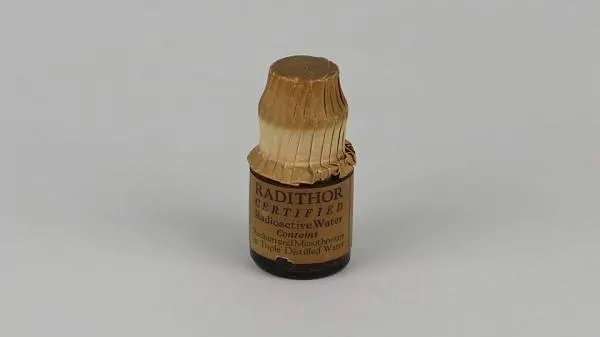
(Photo Credit: National Museum of American History, Smithsonian Institution)