Rare Blue Supermoon graces the night sky on Monday
The blue part doesn’t mean color, it’s all about numbers in a season. According to Space.com, this refers to the traditional term of blue moon, which refers to the third full moon in a season that has four full moons.
More Stories


August’s full moon is coming up Monday, but this one is extra special because it’s a Blue Supermoon.
The blue part doesn’t mean color, it’s all about numbers in a season.
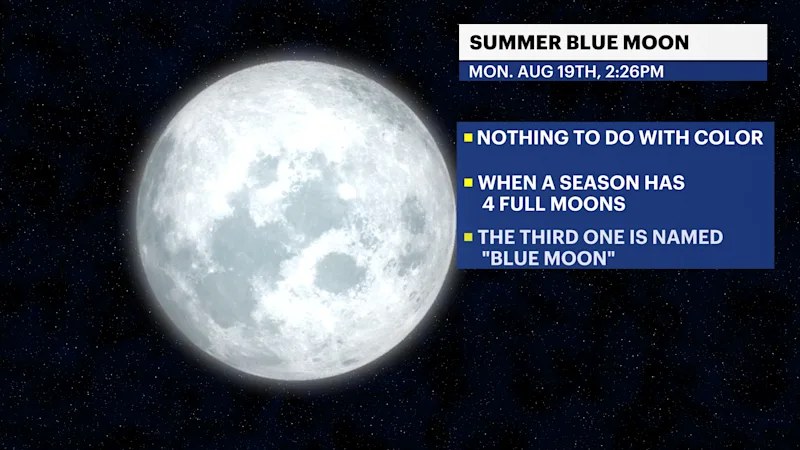
According to Space.com, this refers to the traditional term of blue moon, which refers to the third full moon in a season that has four full moons.
Last August, there was also a blue moon, but that was because it was the second full moon in the calendar month. That version stems from this seasonal definition.
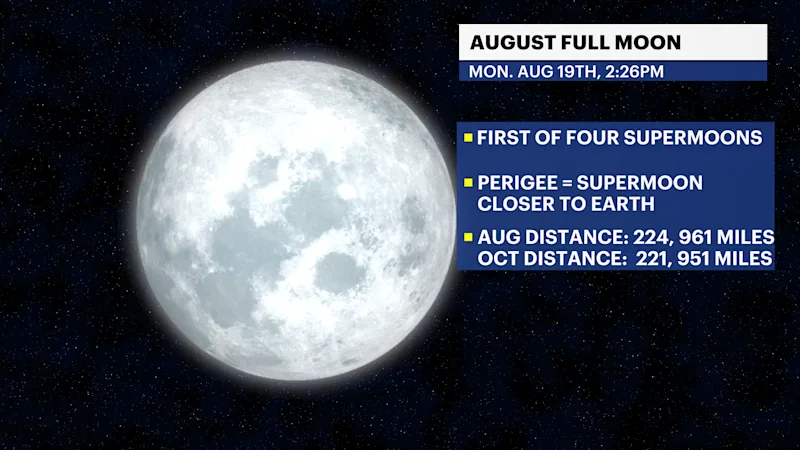
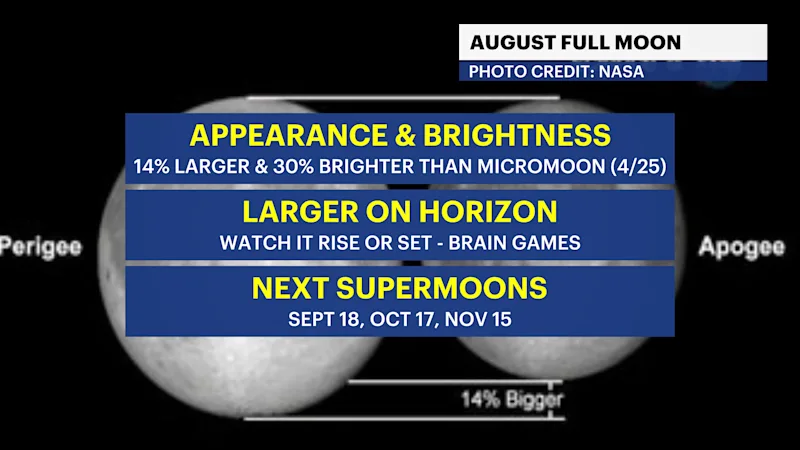
Now onto the super, or not so super part. This moon will be slightly closer to Earth and is now coined as a supermoon. The moon’s orbit around the Earth is not a perfect circle, but more of an ellipse. So at certain times, the moon is either closer or farther away. The closest point is called perigee. At the other end of the scale is the apogee moon, or micormoon. That’s a difference of just over 27,000 miles between the orbital points.
Now the term supermoon isn’t an official astronomical term. It was coined by an astrologer back in the late 1970s. It’s used to describe some of the closer orbits of the year, and according to NASA, the full moons that come within 90% of perigee are considered supermoons. This particular one will be the farthest supermoon for this year, with the closest one being in October. You might also hear that supermoons are larger or brighter. Yes, that’s true but to the casual observer, that’s really hard to tell. Supermoons happen about 3 to 4 times a year and this one will be the first one for this year.
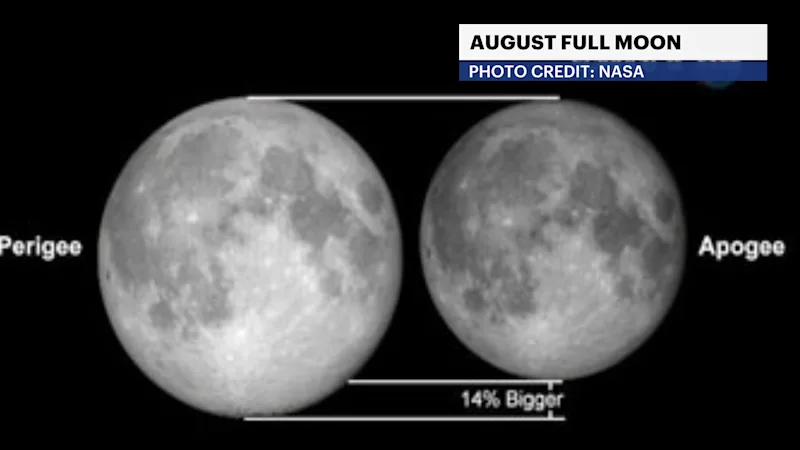
When you compare a moon in perigee with one in apogee, the closer orbit will appear 14% larger and 30% brighter. The moon always looks larger when it’s closer to the horizon, too. That’s known as the moon illusion. It will then appear smaller as it rises higher in the sky. So be sure to catch it as it rises, but that may be difficult with the weather on Monday evening.
The closest full moon in recent memory was back on Nov. 14, 2016. The closest before that was in January of 1948 and an even closer one was back in Jan. 1912. Now in November 2034, that full moon will be the closest of them all. Something to look forward to.